

ECCO2R Therapy
Extracorporeal CO2 removal (ECCO2R) therapy supports healthcare professionals in managing patients with acute respiratory failure (ARF) by safely removing excess CO2.1
ECCO2R can help control the dangers of hypercapnia and deliver the benefits of LPV
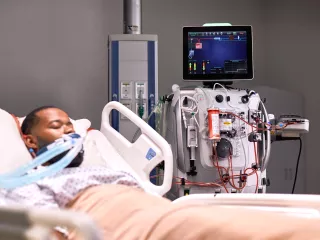
LPV strategies can cause hypercapnia and respiratory acidosis, potentially negating their protective effects.14,15 By removing CO2, ECCO2R can help patients achieve the benefits of LPV.11-13
- LPV strategies (lower tidal volume [VT], lower driving pressure [ΔP], and lower respiratory rate [RR]) limit pressure and volume during mechanical ventilation to reduce the risk of VILI.16-18
- Hypercapnia, especially combined with respiratory acidosis, is associated with increased mortality risk in patients with ARDS.19-22
- ECCO2R therapy can effectively manage hypercapnia to facilitate the use of LPV or UPLV in patients with mild-to-moderate ARDS.11-13
- Compared with traditional mechanical ventilation, LPV strategies have been shown to offer benefits such as:
- Reduced mortality risk (including in-hospital and 28-day mortality)10,14, 23-25
- Increased number of days without non-pulmonary organ failure (days 1–28)14
- Increased number of ventilator-free days (days 1–28)14
- Decreased duration of hospitalization10
Used in patients likely to benefit, ECCO2R can offer patient- and ICU-level advantages.
- In a single-center retrospective study of 73 patients, the authors observed lower mortality when ECCO2R treatment was initiated earlier, although the study was not designed and powered to show a survival benefit.26
- ECCO2R therapy-enabled LPV and UPLV strategies may provide a cost-effective survival benefit in patients with moderate ARDS.25
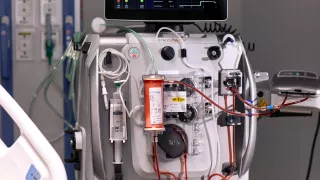
- Low-flow ECCO2R can be delivered through organ support equipment already familiar to critical care HCPs (e.g., CRRT), thus offering substantial operational benefits31
- Low-flow ECCO2R with peristaltic pumps has been shown to effectively clear CO2 without treatment-related complications, such as bleeding.13,28
- Clinicians can provide multiple organ support therapies using a single vascular access, helping to minimize the invasiveness of treatment28,29,32 and reduce the risk of infection for patients with multiple organ dysfunction.33-35
ECCO2R may enable NIV in eligible patients, such as those with aeCOPD, by helping avoid need for intubation.
- International guidelines recommend NIV strategies when possible to lower mortality risk.36
- Severe hypercapnia and respiratory acidosis can cause NIV to fail, leaving patients with no recourse but intubation.37,38
- ECCO2R therapy can help support the use of NIV strategies in patients with aeCOPD by effectively managing acute hypercapnia, thereby reducing the need for intubation.39-41
- Compared with historical controls, ECCO2R use during NIV has been shown to reduce the risk of intubation by 73%.40
ECCO2R therapy may facilitate weaning from IMV in patients with aeCOPD.11,27,42-44
- ECCO2R may help wean patients from IMV, reducing intubation time and hastening recovery.43-47
- The use of ECCO2R to help wean patients with aeCOPD from IMV could help their recovery by allowing oral nutrition and early physiotherapy, thus preventing muscle deconditioning.48
… respiratory diseases are a leading cause of death and disability in the world. “Prevention, control, and cure of these diseases and … promotion of respiratory health must be a top priority for health-care systems and decision makers.49
Forum of International Respiratory Societies
Vantive, PrismaLung+ and PrisMax are trademarks of Vantive Health LLC or its affiliates.
References
-
Wilson ME, Barwise A, Heise KJ, et al. Long-term return to functional baseline after mechanical ventilation in the ICU. Crit Care Med. 2018;46(4):562-569.
-
Grasselli G, Calfee CS, Camporota L, et al. ESICM guidelines on acute respiratory distress syndrome: definition, phenotyping and respiratory support strategies. Intensive Care Med. 2023;49(7):727-759.
-
Papazian L, Aubron C, Brochard L, et al. Formal guidelines: management of acute respiratory distress syndrome. Ann. Intensive Care. 2019;9:69.
-
Evans L, Rhodes A, Alhazzani W, et al. Surviving sepsis campaign: international guidelines for management of sepsis and septic shock 2021. Intensive Care Med. 2021;47(11):1181-1247.
-
Slutsky AS. History of mechanical ventilation. From vesalius to ventilator-induced lung injury. Am J Respir Crit Care Med. 2015;191(10):1106-1115.
-
Gattinoni L and Protti A. Guidelines for the management of chronic kidney disease. CMAJ. 2008;178:1174-1176.
-
Dreyfuss D and Saumon G. Ventilator-induced lung injury: Lessons from experimental studies. Am J Respir Crit Care Med. 1998;157(1):294-323.
-
von Düring S, Parhar KKS, Adhikari NKJ, et al. Understanding ventilator-induced lung injury: The role of mechanical power. J Crit Care. 2025;85:154902.
-
Brodie D, Slutsky AS, Combes A. Extracorporeal life support for adults with respiratory failure and related indications: a review. JAMA. 2019;322(6):557-568.
-
Serpa Neto A, Cardoso SO, Manetta JA, et al. Association between use of lung-protective ventilation with lower tidal volumes and clinical outcomes among patients without acute respiratory distress syndrome: a meta-analysis. JAMA. 2012;308(16):1651-9.
-
Winiszewski H, Aptel F, Belon F, et al. Daily use of extracorporeal CO2 removal in a critical care unit: indications and results. J Intensive Care. 2018;6:36.
-
Combes A, Fanelli V, Pham T, et al. Feasibility and safety of extracorporeal CO2 removal to enhance protective ventilation in acute respiratory distress syndrome: the SUPERNOVA study. Intensive Care Med. 2019;45(5):592-600.
-
Tiruvoipati R, Ludski J, Gupta S, et al. Evaluation of the safety and efficacy of extracorporeal carbon dioxide removal in the critically ill using the PrismaLung+ device. Eur J Med Res. 2023;28(1):291.
-
Acute Respiratory Distress Syndrome Network; Brower RG, Matthay MA, Morris A, et al. Ventilation with lower tidal volumes as compared with traditional tidal volumes for acute lung injury and the acute respiratory distress syndrome. N Engl J Med. 2000;342(18):1301-1308.
-
Stewart TE, Meade MO, Cook DJ, et al. Evaluation of a ventilation strategy to prevent barotrauma in patients at high risk for acute respiratory distress syndrome. Pressure- and Volume-Limited Ventilation Strategy Group. N Engl J Med. 1998;338(6):355-361.
-
Amato MB, Meade MO, Slutsky AS, et al. Driving pressure and survival in the acute respiratory distress syndrome. N Engl J Med. 2015;372(8):747-755.
-
Abrams D, Agerstrand C, Beitler JR, et al. Risks and benefits of ultra-lung-protective invasive mechanical ventilation strategies with a focus on extracorporeal support. Am J Respir Crit Care Med. 2022;205(8):873-882.
-
Costa ELV, Slutsky AS, Brochard LJ, et al. Ventilatory variables and mechanical power in patients with acute respiratory distress syndrome. Am J Respir Crit Care Med. 2021;204(3):303-311.
-
Richard JC, Marque S, Gros A, et al. Feasibility and safety of ultra-low tidal volume ventilation without extracorporeal circulation in moderately severe and severe ARDS patients. Intensive Care Med. 2019;45(11):1590-1598.
-
Nin N, Muriel A, Peñuelas O, et al. Severe hypercapnia and outcome of mechanically ventilated patients with moderate or severe acute respiratory distress syndrome. Intensive Care Med. 2017;43(2):200-208.
-
Tiruvoipati R, Pilcher D, Buscher H, Botha J, Bailey M. Effects of hypercapnia and hypercapnic acidosis on hospital mortality in mechanically ventilated patients. Crit Care Med. 2017;45(7):e649-e656.
-
Gendreau S, Geri G, Pham T, Vieillard-Baron A, Mekontso Dessap A. The role of acute hypercapnia on mortality and short-term physiology in patients mechanically ventilated for ARDS: a systematic review and meta-analysis. Intensive Care Med. 2022;48(5):517-534.
-
Putensen C, Theuerkauf N, Zinserling J, Wrigge H, Pelosi P. Meta-analysis: ventilation strategies and outcomes of the acute respiratory distress syndrome and acute lung injury. Ann Intern Med. 2009;151(8):566-576.
-
Petrucci N, De Feo C. Lung protective ventilation strategy for the acute respiratory distress syndrome. Cochrane Database Syst Rev. 2013;2013(2):CD003844.
-
Amato MB, Barbas CS, Medeiros DM, et al. Effect of a protective-ventilation strategy on mortality in the acute respiratory distress syndrome. N Engl J Med. 1998;338(6):347-354.
-
Cobeta P, Gomis A, Claver S, Encuentra M, Rubin S, Salvador E, Segura P, Tenorio MT, Pestaña D. Extracorporeal CO2 removal in severe respiratory acidotic intubated patients: A seven year experience observational study. Respir Med. 2025 Apr-May;240:108011.
-
Amato MB, Barbas CS, Medeiros DM, et al. Effect of a protective-ventilation strategy on mortality in the acute respiratory distress syndrome. N Engl J Med. 1998;338(6):347-354.
-
Consales G, Zamidei L, Turani F, et al. Combined renal-pulmonary extracorporeal support with low blood flow techniques: a retrospective observational study (CICERO Study). Blood Purif. 2022;51(4):299-308.
-
Nentwich J, Wichmann D, Kluge S, Lindau S, Mutlak H, John S. Low-flow CO2 removal in combination with renal replacement therapy effectively reduces ventilation requirements in hypercapnic patients: a pilot study. Ann Intensive Care. 2019;9(1):3.
-
Redant S, De Bels D, Barbance O, Loulidi G, Honoré PM. Extracorporeal CO2 Removal Integrated within a Continuous Renal Replacement Circuit Offers Multiple Advantages. Blood Purif. 2021;50(1):9-16.
-
Hospach I, Goldstein J, Harenski K, et al. In vitro characterization of PrismaLung+: a novel ECCO2R device. Intensive Care Med. Exp. 2020;8(14).
-
Allardet-Servent J, Castanier M, Seignouret T, et al. Safety and efficacy of combined extracorporeal CO2 removal and renal replacement therapy in patients with acute respiratory distress syndrome and acute kidney injury: the pulmonary and renal support in acute respiratory distress syndrome study. Crit Care Med. 2015;43(12):2570-2581.
-
Dube WC, Jacob JT, Zheng Z, et al. Comparison of rates of central line-associated bloodstream infections in patients with 1 vs 2 central venous catheters. JAMA Netw Open. 2020;3(3):e200396.
-
Joint Commission. Central line-associated bloodstream infections toolkit and monograph. Accessed August 2021. Available at: https://www.jointcommission.org/-/media/tjc/documents/resources/hai/clabsi_monographpdf.pdf.
-
Concannon C, van Wijngaarden E, Stevens V, Dumyati G. The effect of multiple concurrent central venous catheters on central line–associated bloodstream infections. Infect Control Hosp Epidemiol. 2014;35(9):1140-1146.
-
GOLD 2023 Report. 2023. Accessed April 2025. Available at: https://goldcopd.org/2023-gold-report-2/
-
Ozyilmaz E, Ugurlu AO, Nava S. Timing of noninvasive ventilation failure: causes, risk factors, and potential remedies. BMC Pulm Med. 2014;14:19.
-
British Thoracic Society Standards of Care Committee. Non-invasive ventilation in acute respiratory failure. Thorax. 2002;57(3):192-211.
-
Braune S, et al. Intensive Care Med. 2016;42(9):1437–444.
-
Del Sorbo L, Pisani L, Filippini C, et al. Extracorporeal Co2 removal in hypercapnic patients at risk of noninvasive ventilation failure: a matched cohort study with historical control. Crit Care Med. 2015;43(1):120-127.
-
Azzi M, Aboab J, Alviset S, et al. Extracorporeal CO2 removal in acute exacerbation of COPD unresponsive to non-invasive ventilation. BMJ Open Respir Res. 2021;8(1):e001089.
-
Duggal A, Conrad SA, Barrett NA, et al. Extracorporeal Carbon Dioxide Removal to Avoid Invasive Ventilation During Exacerbations of Chronic Obstructive Pulmonary Disease: VENT-AVOID Trial - A Randomized Clinical Trial. Am J Respir Crit Care Med. 2024;209(5):529-542.
-
Augy JL, Aissaoui N, Richard C, et al. A 2-year multicenter, observational, prospective, cohort study on extracorporeal CO2 removal in a large metropolis area. J Intensive Care. 2019;7:45.
-
Abrams DC, Brenner K, Burkart KM, et al. Pilot study of extracorporeal carbon dioxide removal to facilitate extubation and ambulation in exacerbations of chronic obstructive pulmonary disease. Ann Am Thorac Soc. 2013;10(4):307-14.
-
Roncon-Albuquerque R, et al. Intensive Care Med. 2014;40:1969–1970.
-
Pisani L, et al. Am J Respir Crit Care Med. 2015;192(11):1392–1394.
-
Diehl J-L, et al. Intensive Care Med. 2016;42(5):951–952.
-
Combes A, Auzinger G, Capellier G, et al. ECCO2R therapy in the ICU: consensus of a European round table meeting. Crit Care. 2020;24(1):490.
-
Forum of International Respiratory Societies. The Global Impact of Respiratory Disease. 2nd Edition. 2017.